The book
A workbook for self-discovery, not a system to adopt
What the workbook actually is
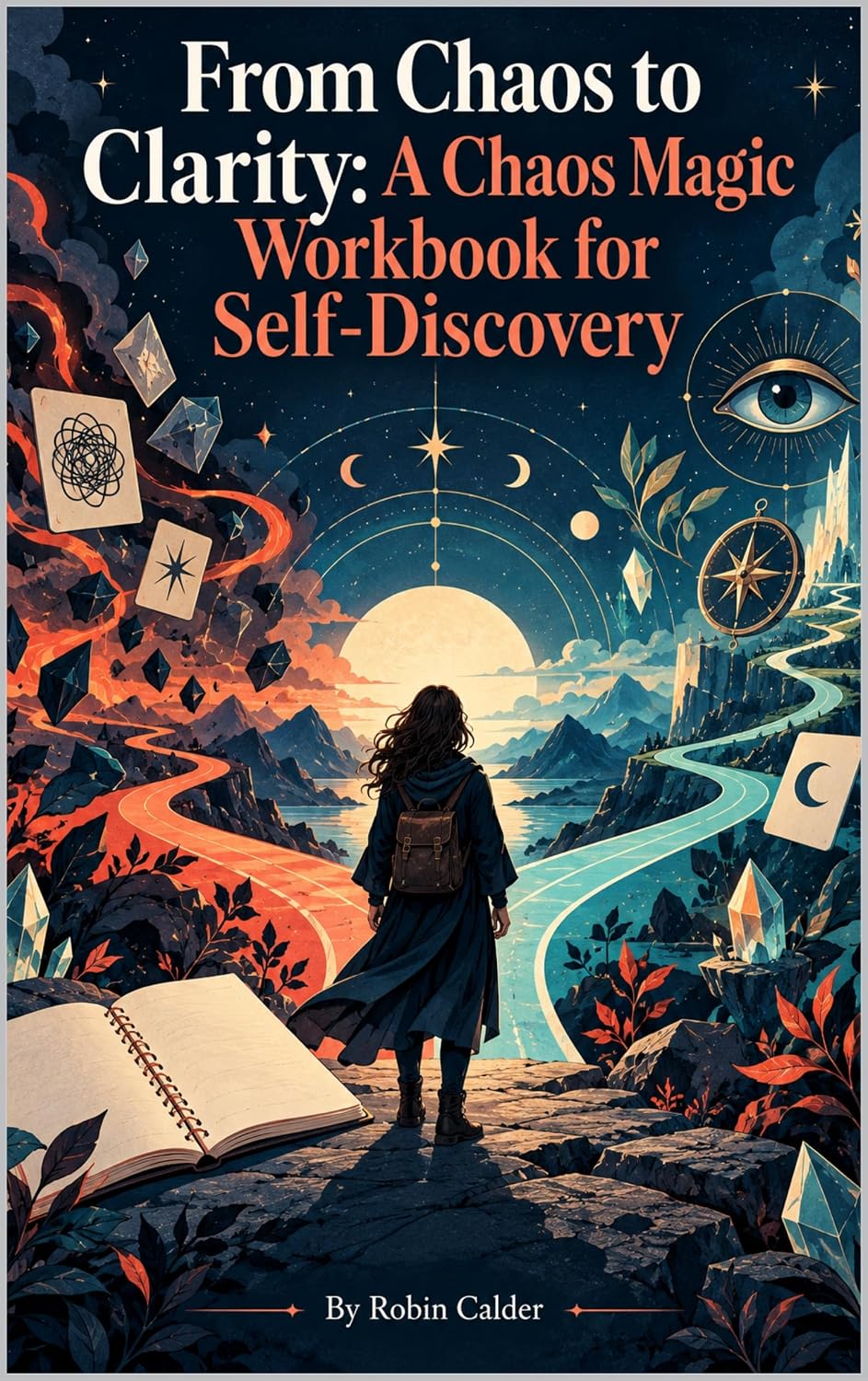
The book brings symbolic practice into everyday decisions. It explores intentions, beliefs, boundaries and uncomfortable reactions through written reflection and practical experiments. The writing is not decoration around the practice; it is the practice. Worksheets and experiment logs build a record you can revisit instead of a memory you have to trust.
Its guiding loop is short enough to remember on a difficult afternoon: Notice, Choose, Experiment, Reflect. You notice the situation and the assumptions you are carrying, choose a modest intention inside your influence, pair a symbolic exercise with an ordinary action, and return to your notes on a planned review date.
Does From Chaos to Clarity require belief in magic?
No. The book’s listing describes a belief-optional workbook. It does not ask readers to abandon existing beliefs and it makes no claim of supernatural effects. Symbolic work is treated as a way of paying attention to what you already think and feel, while meaning and proof are kept as separate questions.
That matters for how you read it. Nothing in the practice depends on you deciding whether a sigil or a card layout has power of its own. What the workbook does ask is that you write down what you intended, what you did, and what you noticed.
Chaos magic without supernatural belief
Readers often arrive at chaos magic through its reputation for improvisation and results, then bounce off the certainty that surrounds it. This workbook takes the opposite route. The symbolic material is used to make an inner situation visible: the obligation you feel, the approval you want, the interpretation you added without noticing.
Because the book treats exercises as reflection rather than treatment, it stays clear of clinical promises. It also stays clear of prediction. Where a symbol or a layout is involved, the point is the question it produces, not a verdict it delivers.
What you need before you start
The equipment is ordinary, and the listing names it plainly: a notebook, writing materials, paper, and a calendar or reminder app. The calendar matters more than it looks. The loop ends with a review date, and a date you never wrote down is a date you will not keep.
- A notebook you are willing to write in badly.
- Something to draw a simple sigil on without redrawing it five times.
- A calendar entry, not a vague intention to look back later.
How the parts of the practice fit together
Each element answers a different question. The loop gives the practice a shape. Sigils turn an intention into something you can hold in view. Divination opens questions you had not thought to ask. Ritual comparison tests whether complexity is doing anything for you. The logs keep all of it honest.
None of these pieces is presented as a technique for bending events. They are ways of structuring attention, then checking what actually happened.
Where the workbook stops
This is a workbook about reflection. It is not therapy, diagnosis or professional advice, and it does not promise that a boundary will be respected or a situation resolved. If a decision involves your health, your safety, your employment rights or someone else’s wellbeing, the book’s exercises can help you think, but they cannot replace qualified help.
Continue through the guide
- The four-step loopWhat happens at each step, including the review date people skip.
- Sigils and ordinary actionWhy the symbolic part is paired with something observable.
- Divination as reflectionHow a layout produces questions instead of a decision.
- Observation vs interpretationKeeping the record free of conclusions you added later.
The listing is the only place to check availability, price and delivery.